Inspired by village life in Pakistan, these photographs are a compelling example of Asian fine-art photography. Amir’s images capture moments of everyday life in Samundharee, conveying a sense of peaceful harmony and the profound simplicity found in village life.
Inspiriert vom Dorfleben in Pakistan sind diese Fotografien ein eindrucksvolles Beispiel asiatischer Kunstfotografie. Amirs Bilder fangen Momente des Alltags in Samundharee ein und vermitteln ein Gefühl friedlicher Harmonie sowie der tiefen Einfachheit dieses bemerkenswerten Dorflebens.


Between the monumental Himalayas and the quiet landscapes of Samundhari lies a rich visual world shaped by altitude, water, agriculture, and everyday life. The Himalayas extend across roughly 2,500 kilometres, forming a dramatic mountain system between the Indian subcontinent and the Tibetan Plateau; their glaciers and rivers sustain communities far beyond the high valleys.
Samundhari, by contrast, evokes the intimate scale of village life in Pakistan: paths bordered by fields, animals resting in the shade, modest homes, and people moving through the rhythms of work and family. While the mountains express grandeur and distance, the village reveals closeness—the texture of a wall, the warmth of a courtyard, the changing light across cultivated land. Together, these regions offer nature photography two complementary subjects. The Himalayas invite images of vastness: snow-covered peaks, deep valleys, cloud, rock, and rivers descending from high ground. Samundhari invites a more human gaze, one attentive to ordinary gestures and the peaceful relationship between people, landscape, and season.
This contrast is central to the artistic character of the region. Nature is not separate from culture; it is present in the water carried home, the fields cultivated by hand, the animals that share the village, and the mountains that shape weather and imagination. The Himalayan system influences climate, river networks, biodiversity, and the cultural life of the surrounding region.
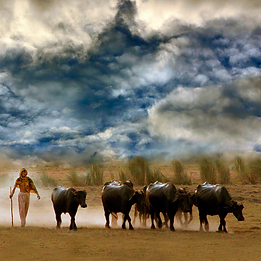


A photographic series moving between the Himalayas and Samundhari could become more than a collection of scenic views. It could be a study of scale: from immense peaks to intimate domestic spaces, from ancient geological forces to a single human moment. In both settings, the camera can discover a quiet harmony—not an untouched paradise, but a living world shaped by endurance, simplicity, and change.
The power of such photographs lies in their restraint. Rather than presenting Pakistan and the wider Himalayan region as exotic destinations, they can allow the land to speak through atmosphere and detail: the haze above a valley, the geometry of a field, the shadow of a mountain, or the stillness of a village afternoon. Here, beauty emerges not only from spectacle, but from attention.
The most compelling work also resists the idea of untouched wilderness. Asian landscapes are shaped by agriculture, pilgrimage, industry, migration, and climate change. Photographers increasingly use the camera not only to preserve beauty, but also to draw attention to fragile habitats and the communities whose lives depend on them.